- Home Page /
- Books /
- Science & Math /
- Chemistry /
- Crystallography /
- Physical Properties Of Crystals: Their Repres...

Item #:
4743981
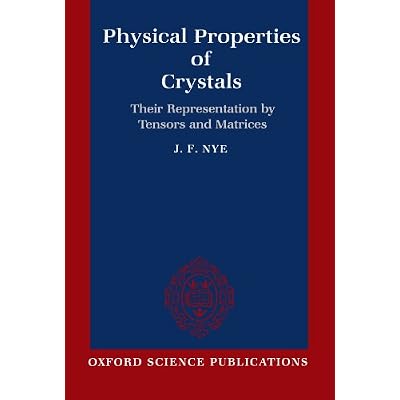
Physical Properties Of Crystals: Their Representation by Tensors and Matrices Reprint Edition
Item #:
4743981
XAF 106340
Price Details
Excluding Shipping & Custom charges ( Shipping and custom charges will be calculated on checkout )
*All items will import from US
0 ratings
Write a review
In stock
 Imported from USA store
QTY:
Order now and get it around Tuesday, September 01
Secured transaction
Ubuy works hard to protect your security and privacy. Our advanced payment security system ensures confidentiality by encrypting your information during transmission using AES (Advanced Encryption Standards) and SSL (Secure Socket Layer) protocols. Your payment details are 100% secure as we do not share your payment details with third party sellers.
Our Top Logistics Partners


The author formulates the physical properties of crystals systematically in tensor notation

Fast
Shipping

Free
Return*

Secure Packaging

100% Original Products

PCI DSS Compliance

ISO 27001 Certified



Note: Step Down Voltage Transformer required for using electronics products of US store (110-120). Recommended power converters Buy Now.


What Stands Out
Comprehensive Coverage
This product offers an in-depth exploration of the physical properties of crystals, making it ideal for researchers and students seeking to understand complex concepts through a clear, structured approach.
Matrix Representation
Utilizing tensors and matrices, the book presents crystal properties in a mathematically rigorous way, catering to advanced learners and professionals who require precise methodologies in materials science and engineering.
Visual Aids
Incorporating diagrams and visual representations enhances comprehension, allowing readers to easily grasp intricate tensor-based relationships, thereby improving their practical application in real-world scenarios.
Product Details
- Classic study first published in 1957, now reissued in a paperback version with additional updated chapter
- Formulates physical properties of crystals in tensor notation
- Presents tensor properties in terms of their common mathematical basis and thermodynamic relations
- Lays mathematical groundwork with a discussion of tensors of the first and second ranks
- Introduces tensors of higher ranks and matrix methods as natural developments of the theory
- Discusses thermodynamic and optical aspects in a similar pattern
| Publisher | Oxford University Press, U.S.A. |
| Publication date | June 20, 2002 |
| Edition | Reprint |
| Language | English |
| Print length | 352 pages |
| ISBN-10 | 0198511655 |
| ISBN-13 | 978-0198511656 |
| Item Weight | 1.3 pounds (590 grams) |
| Dimensions | 0.78 x 9.25 x 6.13 inches (2 x 23.5 x 15.6 cm) |
| Country of Origin | This item will be imported from US |
| Date First Available | June 09, 2021 |
| What is in the box | Physical Properties Of Crystals:... For more details, please check description/product details |
Who Should Buy?

-
Researchers in Physics
Ideal for physicists researching crystallography and materials science, providing essential insights into tensor representations.
-
Materials Scientists
Valuable for materials scientists focusing on crystallographic properties and their applications in developing new materials.
-
Graduate Students
Excellent resource for graduate students studying solid-state physics, offering foundational knowledge in crystallography.

-
Casual Readers
Not suitable for casual readers lacking a solid background in physics or materials science concepts.
Product Description
Physical Properties Of Crystals: Their Representation by Tensors and Matrices Reprint Edition
Have any Query? Chat with us
Customer Questions & Answers
-
Question:
What are the main physical properties of crystals discussed in the book?
Answer: The book 'Physical Properties of Crystals: Their Representation by Tensors and Matrices' explores essential properties such as elasticity, dielectric constants, and thermal conductivity. Each property is represented in terms of tensors and matrices to provide a comprehensive understanding of how crystals respond to external forces. This is crucial for various applications in materials science, engineering, and condensed matter physics, where understanding these properties aids in the design and optimization of new materials. -
Question:
How does the book explain the representation of crystals using tensors?
Answer: The book employs a rigorous mathematical approach to explain how tensors represent the properties of crystals. Tensors are multi-dimensional arrays that encapsulate the directional dependence of physical properties, which is essential in crystals due to their anisotropic nature. By utilizing specific examples and equations, the book illustrates how to derive these representations, making it a valuable resource for researchers and students aiming to grasp the complexities of crystal behavior in various applications. -
Question:
Can this book help in understanding the mechanical properties of crystals?
Answer: Absolutely! This book significantly enhances the understanding of mechanical properties such as stress, strain, and elasticity in crystals. It delves into how these properties can be quantified and analyzed through tensor representations, which is critical for predicting material behavior under different loading conditions. Engineers and material scientists can benefit greatly from this knowledge, especially when developing stronger and more durable materials for various industrial applications. -
Question:
Is prior knowledge of tensor mathematics required to understand the content?
Answer: While a basic understanding of linear algebra would be beneficial, the book is structured to gradually introduce concepts of tensor mathematics in the context of crystals. It balances detailed theoretical explanations with practical examples, so readers with varying levels of expertise can follow along. For those ready to dive deeper into the subject, this book serves as an excellent stepping stone into advanced topics within material science and condensed matter physics. -
Question:
What kind of applications can I expect to explore after reading this book?
Answer: After reading this book, readers can apply their knowledge to various fields such as materials engineering, solid-state physics, and nanotechnology. Understanding the physical properties and their mathematical representations will allow professionals to contribute to innovations in electronics, optics, and new material development. The insights gained can lead to advancements in designing stronger alloys, optimizing semiconductor devices, and enhancing optical materials, thus broadening career prospects and research opportunities. -
Question:
Does the book include practical examples and exercises for better understanding?
Answer: Yes, 'Physical Properties of Crystals: Their Representation by Tensors and Matrices' includes numerous practical examples, case studies, and exercises. These facilitate hands-on practice, reinforcing concepts discussed in the text. By working through these examples, readers can deepen their comprehension of how theoretical principles apply in real-world scenarios, ultimately enhancing their analytical and problem-solving skills within the field of crystal physics and materials science. -
Question:
Who is the intended audience for this book?
Answer: The book is primarily aimed at graduate and postgraduate students in materials science and physics, as well as professionals and researchers in related fields. It serves as an advanced textbook that offers in-depth insights into crystal physics, making it suitable for those who seek to specialize in the physical properties of solids. Additionally, academics looking for a comprehensive reference will find the material invaluable for their research and teaching endeavors. -
Question:
What makes this book different from others on crystal physics?
Answer: What sets this book apart is its unique focus on the mathematical representation of crystal properties through tensors and matrices, providing a deeper analytical perspective. Many books touch on crystal physics lightly, while this work offers a thorough examination of how these advanced mathematical tools apply to real-world properties of crystals. This specialized approach equips readers with a more profound understanding essential for academic research and industrial applications. -
Question:
How does the book contribute to advancements in materials science?
Answer: This book contributes to materials science by providing a structured framework to analyze and predict the behavior of materials under various conditions. Understanding these physical properties at a fundamental level allows scientists and engineers to innovate and refine materials for specific applications. This knowledge is crucial in fields such as nanotechnology, electronics, and biomaterials, where precise material characteristics can lead to significant technological advancements. -
Question:
Where can I buy Physical Properties Of Crystals: Their Representation by Tensors and Matrices?
Answer: You can purchase 'Physical Properties Of Crystals: Their Representation by Tensors and Matrices' on Ubuy, a convenient platform that offers a wide selection of books and academic resources. Ubuy provides an accessible way to find this specialized text, ensuring a smooth purchasing experience tailored to your needs.
Crystallography Editorial Review
An editorial review for "Physical Properties of Crystals: Their Representation by Tensors and Matrices" based on customer feedback: "Physical Properties of Crystals: Their Representation by Tensors and Matrices" is a classic book that offers a clear exposition of crystal properties and their representation using tensors and matrices. The book is easy to read and highly informative, assuming a good knowledge of E&M and similar topics. The book is best suited for people who have some idea about space groups and point groups in crystallography. Knowledge of those concepts is not necessary, but it makes it easier for people who have that knowledge. Being from a mechanical background might make it a bit challenging to follow the author's explanation of determining properties of second rank tensors by comparing them to quadrics. The author methodically and somewhat rigorously presents the arguments behind why certain property tensors take on specific characters for different crystalline materials. The author ties things to geometric interpretations rather than algebraic, making it easier to understand. Similarly, if you aren't familiar with the physics related to the property, or it has been a while, the author briefly reviews what is relevant and where in the governing equations the properties fit. The book is more than just the symmetry of the lattice; there are thermodynamic arguments to be made as well, and the author highlights the high points of these as well. The author gives values for the different Constants at room temperature for different materials, and in some cases discusses issues with the measurement of the Constants. Overall, "Physical Properties of Crystals: Their Representation by Tensors and Matrices" is an excellent book for understanding how crystal properties depend on the inherent symmetries present in a crystal and how, by reducing the number of independent Constants, the math can be simplified to a great extent. If you are interested in studying wave propagation in anisotropic media, this book is not ideal, but Hearmon's book "An Introduction to Applied Anisotropic Elasticity" might be more suited once you know the number of independent elastic Constants for a particular crystal lattice. If you are interested in knowing how to determine the independent Constants, Love's book "A Treatise on the Mathematical Theory of Elasticity (Dover Books on Engineering)" has a good account of that.
Customer Reviews & Ratings
1 customers ratings
-
5 Star
100%
-
4 Star
0%
-
3 Star
0%
-
2 Star
0%
-
1 Star
0%
Review this product
Share your thoughts with other customers
Pros
- Clear exposition
- Highly informative
- Easy to read
- Excellent for understanding how crystal properties depend on the inherent symmetries present in a crystal
- Offers values for different Constants at room temperature for different materials
Cons
- May be challenging for individuals without a knowledge of space groups and point groups
Platform Trust & Buyer Confidence

MA
Mohammad
Verified buyer
“Excellent quality and original too,when ubuy send original things I will appreciate that ,I very satisfied thank you”
23 July 2026 · via Trustpilot
CK
Chitra
Verified buyer
“The order and delivery progress was communicated very well. Package arrived within the estimated time. Products arrived as expected in good condition.”
22-Jul-26 · via Trustpilot
K
kund
Verified buyer
“Good supply of products. Safe payment methods, and shipment worldwide! Genuine products.”
23-Jul-26 · via Trustpilot
OO
Onesi
Verified buyer
“Was my first time buying a product from Ubuy, but I found it so helpful. This is reliable. Gonna place a new order!”
22 July 2026 · via Trustpilot
SJ
SAO JOHN
Verified buyer
“Ubuy is a great online platform to buy stuff. Reliable, fast delivery time and great value for money. I've been using Ubuy online shopping platform for three years now and will continue to do so.”
23 July 2026 · via Trustpilot
Secure Checkout
Global Delivery
Easy Returns
Genuine Products
Product Price History
Important information
- Limitations : For products shipped internationally, please note that any manufacturer warranty may not be valid; manufacturer service options may not be available; product manuals, instructions, and safety warnings may not be in destination country languages; the products (and accompanying materials) may not be designed in accordance with destination country standards, specifications, and labeling requirements; and the products may not conform to destination country voltage and other electrical standards (requiring use of an adapter or converter if appropriate). The recipient is responsible for assuring that the product can be lawfully imported to the destination country. When ordering from Ubuy or its affiliates, the recipient is the importer of record and must comply with all laws and regulations of the destination country.
- Not all the products listed on Ubuy are for sale, as Ubuy is a global search engine. Products are subject to export/trade regulations.
XAF 106340
Order now and get it around Tuesday, September 01
This item is not restrict in my country.(Please click on above link if this item is not restrict in your country, So our team will review and allow.)
QTY:
Secured transaction
PCI DSS compliant and ISO 27001:2022 certified, with encrypted payments and full buyer protection on every order.
Our Top Logistics Partners
Fastest cross-border delivery
Features & Benefits
- First published in 1957
- Includes an additional chapter updating the material
- Presents tensor properties in terms of their mathematical basis
- Discusses tensors of the first and second ranks
- Introduces higher rank tensors and matrix methods
- Covers thermodynamic and optical aspects
Ubuy Assurance
Experience worry-free shopping with 100% original products, PCI DSS-compliant payment security, ISO 27001-certified data protection, the fastest cross-border delivery, free returns *, and secure packaging on every order.